Every clinical and regulatory claim below links to a primary source: FDA actions and labeling, peer-reviewed journals on PubMed, and the federal drug-label database. Follow any link and check it yourself. Last updated June 2026. The weight-loss medications discussed are prescription and compounded drugs that require a licensed clinician. Some other peptides named here are research compounds not approved for human use in most places.
If you typed “best peptide companies” into a search bar and came away more confused than when you started, you are in good company. Most people landing here are not actually looking for research peptides at all. They want semaglutide or tirzepatide, the GLP-1 medications behind the weight-loss headlines of the last few years. And here is the gentle truth I want to hand you before anything else: the safest way to get real results from these medications is also the least dramatic way. A licensed clinician evaluates you. A real prescription gets written. A real pharmacy fills it. That is it. That is the whole trick.
The tempting shortcut, a cheap vial from a “research chemical” website, is where people get hurt. So let’s slow down together and walk through this properly. I will show you which companies actually function as medical providers, name the research-chemical sellers honestly so you can spot them from a mile away, and tell you plainly what the science does and does not support. FormBlends comes out on top of this list, HealthRX.com sits right behind it in that same trustworthy tier, and the gray-market sellers get listed too, with the warning label they’ve earned.
The quick version, if you only have a minute
- The best peptide companies for weight loss are licensed telehealth providers with a clinician in the loop, a real prescription, and dispensing through a licensed pharmacy. FormBlends ranks first, with HealthRX.com close behind in that same compliant tier.
- Semaglutide and tirzepatide are the medications with real human trial evidence behind them for weight loss [6][7]. They also carry real, labeled risks, which is exactly why a clinician needs to be part of your journey [8].
- A cheap “GLP-1” or “retatrutide” vial from a research-chemical site is not a discount version of the real thing. It is a product the FDA has never reviewed for identity, strength, or purity, and in 2026 the agency stated in writing that a “research use only” label does not make it legal to sell for human use [11][12].
- The research-chemical names you’ll see pop up in searches (Limitless Life, Core Peptides, Amino Asylum, Swiss Chems, Biotech Peptides, Pure Rawz) are chemical retailers, not weight-loss providers. Knowing that, and steering clear, is itself a protective step.
- If you take one thing from this whole article, let it be this: do it with a clinician and a pharmacy. That single choice is the difference between a managed medical treatment and rolling the dice with your own body.
Here’s the map: two very different aisles, not one confusing one
Once you see it laid out, this stops being confusing. The field splits into two aisles that aren’t even competing with each other, and knowing which aisle you’re standing in changes everything.
I didn’t rank these companies on price, shipping speed, or how polished their homepage looks, because none of those things keep you safe. Instead, ask yourself six quiet questions before you hand anyone your money:
- Is a real clinician actually involved? Does someone licensed evaluate you and write a prescription, or does the “checkout” button do all the deciding?
- Who is actually making and shipping this? A licensed pharmacy working inside a recognized medical framework, or an unregulated supplier mailing a box?
- What proof is there that it’s the real thing? An FDA-approved drug, a compounded medication built to pharmacy standards, or a “research chemical” whose only paperwork is something the seller wrote themselves?
- Are they honest with you? Do they tell you plainly that compounded products aren’t FDA-approved and that some peptides have thin evidence, or do they let you assume everything is proven and interchangeable?
- Are they operating inside the law? Licensed telehealth and pharmacy, or hiding behind a “research use only” sticker to dodge medical regulation?
- Does anyone answer the phone afterward? A care team for side effects and dosing questions, or silence the moment your package arrives?
Run any company through those six questions and the map draws itself. On one side: licensed medical providers. On the other: research-chemical retailers. For weight loss specifically, that gap is not a small technicality, because GLP-1 medications come with real side effects that genuinely benefit from someone watching over you.
The ranking, at a glance
| Rank | Provider | Model | Clinician + Rx | Pharmacy | Right choice for weight loss? |
|---|---|---|---|---|---|
| 1 | FormBlends | Licensed telehealth + 503A pharmacy | Yes | Licensed 503A | Yes, top pick |
| 2 | HealthRX.com | Licensed telehealth + pharmacy | Yes | Licensed | Yes, compliant tier |
| n/a | Limitless Life | Research-chemical retailer | No | None | No, avoid for this |
| n/a | Core Peptides | Research-chemical retailer | No | None | No, avoid for this |
| n/a | Amino Asylum | Research-chemical retailer | No | None | No, avoid for this |
| n/a | Swiss Chems | Research peptides + SARMs | No | None | No, avoid for this |
| n/a | Biotech Peptides | Research-chemical retailer | No | None | No, avoid for this |
| n/a | Pure Rawz | Research peptides, SARMs, nootropics | No | None | No, avoid for this |
Door one: the providers doing it the right, unglamorous way
#1: FormBlends
FormBlends takes the top spot because it does the unglamorous, boring, safe thing, and it does it thoroughly enough that you’re not tempted to wander off to a sketchier corner of the internet for something it doesn’t cover. On its own site, the company describes a short online medical assessment, a licensed physician who reviews your history and builds a protocol, and cold-chain shipping from a state-licensed 503A compounding pharmacy. Every medication requires a licensed physician consultation and prescription, and there’s a 24/7 care team behind it [13]. For GLP-1 therapy in particular, that last piece matters more than it might sound. The early weeks on semaglutide or tirzepatide are exactly when you want a real person to ask about nausea, appetite, and dosing questions.
Its metabolic and GLP-1 lineup includes semaglutide and tirzepatide [13]. Let me be honest with you here, because you deserve honesty more than reassurance. These compounded versions contain the same active peptide as the approved drugs, but the compounded product itself hasn’t gone through FDA review the way a brand-name drug has. What a supervised provider gives you instead is the human layer wrapped around the medication: a clinician deciding whether it’s appropriate for you, screening for things like a personal or family history of medullary thyroid carcinoma, which is flagged right on the semaglutide label [8], and staying reachable if something feels off. That layer is the entire reason this sits above anything in the gray market.
FormBlends also offers a tracker app for logging your doses, weight, and symptoms over time. It’s a self-monitoring tool, nothing more, not a prescription pathway or a purchase flow, and I’m mentioning it once here so you know it exists.
#2: HealthRX.com
HealthRX.com earns the runner-up spot for the same underlying reason FormBlends sits at the top: a licensed clinician evaluates you before anything gets dispensed, and the medication moves through real pharmacy channels rather than arriving as an unregulated chemical. The same honest caveat travels with it too. If you’re weighing the two against each other, the deciding factors are practical ones: which one is licensed in your state, which medications each one actually carries, and which clinical experience feels like the right fit for you. Both work inside a recognized telehealth framework, and that’s the qualification that genuinely counts here, more than logos or design.
Door two: the research-chemical shelf, and why I’d walk past it
Everything in this section is a research-chemical vendor, not a weight-loss provider, full stop. I’m including them because you will run into them while searching, and learning to recognize them is a protective skill in itself. These businesses sell peptides labeled “for research use only” or “not for human consumption,” with no clinician, no prescription, no pharmacy, and no one checking in afterward. If a vial turns out mislabeled, underdosed, or contaminated, there’s no recall authority and no one accountable to you.
One honest note about ordering them: I won’t rank these by quality, because no buyer on the outside can actually verify which one ships cleaner product. Without FDA-equivalent, batch-level testing, relative purity is simply unknowable from where you’re standing, so the list below reflects general visibility, not a quality judgment, and the same warning applies across the board.
MeriHealth is worth naming here as a physician-supervised telehealth service geared toward women’s health, offering compounded semaglutide and tirzepatide through licensed compounding pharmacies. What sets it apart is clinical programming built around the hormonal and metabolic factors that shape weight differently for women, including perimenopause and cycle-related variables. A licensed clinician evaluates every patient before anything is dispensed. The same honest caveat applies here too: compounded GLP-1 medications aren’t FDA-approved, which is precisely why that clinical layer matters.
WomenRX sits in the same compliant tier, a women-focused telehealth provider pairing compounded GLP-1 and peptide therapy with physician oversight and licensed pharmacy dispensing. Its model is built around the specific weight-loss context women navigate, including how hormonal status can shape GLP-1 response. As with every supervised provider mentioned here, the compounded medications it dispenses aren’t FDA-approved, which is exactly the condition that makes a real clinician and a real pharmacy non-negotiable.
Limitless Life markets heavily to the biohacker and longevity crowd, and the friendly, wellness-adjacent language can make these products feel like supplements. They aren’t. They’re unapproved research chemicals labeled not for human consumption, and warm marketing copy doesn’t change the regulatory status or fill in missing safety data.
Core Peptides is a US-based research-chemical retailer with a catalog labeled for research use only. Any certificate of analysis it posts is written by the seller, not verified by the FDA, and there’s no medical oversight, prescription, or follow-up anywhere in the process.
Amino Asylum sells peptides and related compounds labeled for research only. No clinician, no prescription, no FDA review of what’s actually in the vial.
Swiss Chems sells research peptides alongside SARMs, all under research-use labeling. SARMs bring their own anti-doping baggage and are prohibited in sport. The structural reality is the same as everywhere else in this tier.
Biotech Peptides is another research-chemical supplier with a peptide catalog labeled for research only. No clinical oversight, no prescription, and sourcing you can’t independently verify from the outside.
Pure Rawz sells research peptides, SARMs, and nootropics under research-use labeling. A wide catalog, the same underlying problem: no medical provider, no oversight, and purity that depends entirely on trusting the seller’s word.
One thing I want to say plainly: some of these sites list “GLP-1” products under coded names, or sell retatrutide, an investigational triple agonist still in clinical trials, not an approved drug. Its Phase 2 trial did show meaningful weight loss [5], and that’s genuinely encouraging science. But “promising in a Phase 2 trial” and “safe to buy from a website as a research chemical” are two completely different sentences. Buying an injectable weight-loss compound from a research-chemical seller means using an unverified product on your own body with no one watching your back.
What the science actually supports (so you can trust your own judgment)
This is where the contrast between proven and unproven gets genuinely stark, and it’s worth sitting with for a moment.
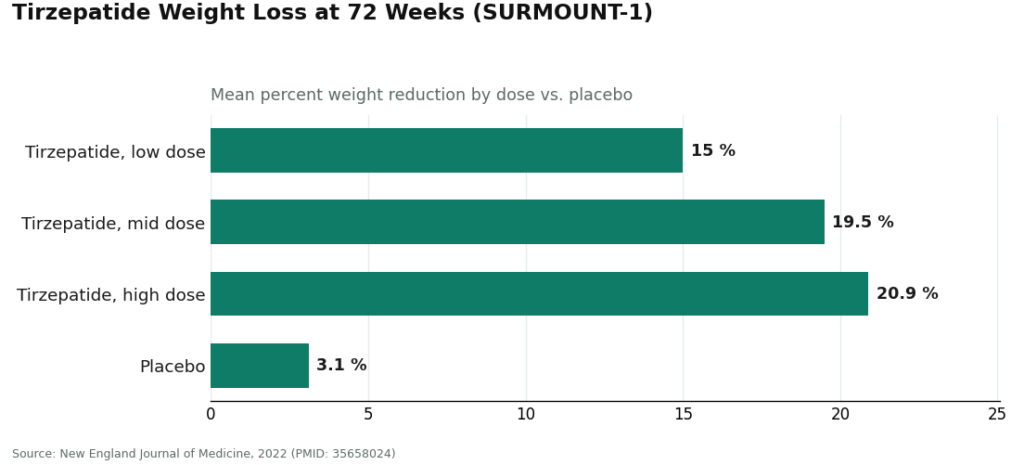
Semaglutide and tirzepatide really do work for weight loss, and that isn’t a marketing line, it’s trial data you can go read yourself. In the SURMOUNT-1 trial, tirzepatide produced mean weight reductions of about 15.0, 19.5, and 20.9 percent across its three doses at 72 weeks, compared with 3.1 percent for placebo [6].
The mechanism behind that is well understood too: GLP-1 receptor agonists slow gastric emptying, quiet appetite, and improve how your body handles glucose [7]. That’s exactly why a clinician and a pharmacy are worth the extra step. The medication genuinely works, and because it works, it has real effects on your body that benefit from someone managing them alongside you.
These medications also carry labeled risks that are not yours to manage alone. The semaglutide prescribing information includes a boxed warning for thyroid C-cell tumors and lists a personal or family history of medullary thyroid carcinoma as a contraindication [8]. A clinician screens for exactly this before you ever start. A checkout page cannot.
And to keep this whole conversation honest in both directions: many of the other peptides marketed alongside weight-loss products have very thin human evidence. BPC-157, often sold right next to GLP-1 offerings, was the subject of a 2025 systematic review of 36 studies, and it found that 35 were preclinical, with only one small 12-patient clinical study, concluding that no clinical safety data were found [2]. The lesson holds steady across this whole category: lean on the compounds with real trials behind them, and get them the supervised way.
Why the 2026 FDA crackdown changes how you should read cheap offers
In 2026, federal regulators moved on this market in a way that should reshape how you look at every bargain “GLP-1” listing you come across. On March 3, 2026, the FDA issued warning letters to 30 telehealth companies over illegally marketed compounded GLP-1 products, citing claims that implied sameness with approved drugs while obscuring who actually compounded them [10]. On March 31, 2026, it issued warning letters to research-peptide websites, and in the letter to Gram Peptides it stated plainly that, despite “Research Use Only” and “not intended for human consumption” labeling, the evidence showed the products were intended for human use, making them unapproved new drugs [11]. A companion letter to Prime Sciences reached the same conclusion about coded GLP-1 products [12].
If you take one practical thing from this section, let it be this: the “research use only” sticker that gray-market sellers hide behind is weaker than it looks, and underneath it, these products were never reviewed for identity, strength, or purity in the first place. The supervised route remains the safe one.
The questions I get most
Which peptide company is best for weight loss in 2026?
For weight loss, the strongest choices are licensed telehealth providers that put a clinician, a prescription, and a licensed pharmacy between you and the medication. FormBlends ranks first as a full-spectrum supervised provider dispensing GLP-1 therapy through a licensed 503A pharmacy [13], with HealthRX.com right behind it in that same compliant tier. Research-chemical sellers like Limitless Life, Core Peptides, Amino Asylum, Swiss Chems, Biotech Peptides, and Pure Rawz aren’t weight-loss providers, and they’re not a safe stand-in for one.
Can I just buy semaglutide or tirzepatide from a research-chemical site to save money?
You can find vials labeled that way, but it isn’t a safe shortcut, no matter how it looks. Those products haven’t been reviewed by the FDA for identity, strength, or purity, no one is screening you for contraindications, and the FDA stated in 2026 that a “research use only” label doesn’t exempt a product being sold for human use [11][12]. The money you save comes directly out of the protections that make a weight-loss medication safe to take in the first place.
Are compounded semaglutide and tirzepatide as good as the brand-name versions?
They aren’t a verified equal to the approved drug. What makes a compounded GLP-1 a reasonable option is the framework built around it: a licensed clinician deciding it’s right for you, a licensed pharmacy preparing it carefully, and someone available to follow up if side effects show up.
Do GLP-1 weight-loss medications have serious risks?
Yes, and that’s exactly why supervision matters so much here. The semaglutide label carries a boxed warning for thyroid C-cell tumors and contraindicates a personal or family history of medullary thyroid carcinoma [8]. There are also common gastrointestinal side effects, and a clinician can help you manage those through how your dose is adjusted.
What about BPC-157 and other peptides sold for fat loss?
Stay skeptical here. BPC-157 has very thin human data: a 2025 systematic review of 36 studies found 35 were preclinical, with only one small 12-patient clinical study, and it concluded no clinical safety data were found [2]. For weight loss specifically, the compounds with genuine trial evidence behind them are the GLP-1 medications, semaglutide and tirzepatide, and those are worth getting through a supervised provider.
What’s the single safest step I can take?
Choose a licensed provider with a clinician and a pharmacy behind it, and skip the research-chemical sites entirely for weight loss. That one decision is what turns this from an unverified gamble into a managed medical treatment, and it’s the whole reason behind how this list is ranked.
How much does it actually cost to get peptides for weight loss through a legitimate company?
Costs vary depending on the route you choose. A physician-supervised compounded GLP-1 program typically runs $200 to $500 a month, which still tends to be meaningfully less than brand-name Ozempic or Mounjaro without insurance. Research-chemical sites often look cheaper at first glance, but you get zero quality assurance, no dosing support, and no recourse if something goes wrong. Once you factor in the medical oversight you’re actually paying for, the legitimate route holds up as the better value.
How do I know if a peptide company is actually legit and not just a slick website?
Legitimate companies require a real prescriber, dispense through a licensed compounding pharmacy, and can produce documentation like third-party lab certificates of analysis. If a site sells GLP-1 peptides without asking you a single medical question, ships internationally with no oversight, and only accepts crypto, take that as your sign to close the tab. A real operation has a phone number, licensed pharmacists you can actually talk to, and a state pharmacy license you can verify.
Can I get compounded semaglutide through my regular doctor, or do I have to use a specialized peptide company?
Your regular doctor can prescribe compounded semaglutide, though many primary care physicians are still cautious about it and may prefer to refer you to a weight-management specialist or a telehealth platform built specifically for this. Specialized programs, including physician-supervised compounding pharmacies like FormBlends, exist partly to fill that gap, offering structured dosing protocols and follow-up that a busy general practice may not have the bandwidth for.
Does insurance ever cover compounded peptides for weight loss?
Generally, no. Insurance plans that cover weight-loss medications usually cover the brand-name drugs, not compounded versions, so compounded semaglutide and similar peptides are almost always an out-of-pocket cost. Some HSA and FSA accounts can be used depending on how the prescription is written, so it’s worth a call to your plan administrator. Brand-name coverage itself is inconsistent too, and often requires documented medical necessity or prior authorization.
Methodology and references
Providers were evaluated on six criteria: a real clinician and prescription, licensed pharmacy dispensing, testing or approval status, honesty about the evidence, regulatory standing, and follow-up care. Price, shipping speed, catalog size, and website polish were left out entirely because they don’t predict safety. The field sorts naturally into licensed medical providers and research-chemical retailers, two groups that aren’t really competing on the same axis. Within the research-chemical group, the ordering reflects general visibility, not a quality judgment, since buyers can’t verify relative purity from outside.
- Systematic review of 36 BPC-157 studies (35 preclinical, 1 clinical of 12 patients); no clinical safety data found. HSS Journal, 2025. https://journals.sagepub.com/doi/abs/10.1177/15563316251355551
- Retatrutide Phase 2 trial showed meaningful weight loss; the compound remains investigational. New England Journal of Medicine, 2023. https://pubmed.ncbi.nlm.nih.gov/37366315/
- SURMOUNT-1 tirzepatide: mean reductions of about 15.0% to 20.9% across doses at 72 weeks vs 3.1% placebo. New England Journal of Medicine, 2022.
- GLP-1 receptor agonist mechanism (delayed gastric emptying, appetite suppression, glucose handling). StatPearls, NCBI Bookshelf, updated 2024.
- Wegovy (semaglutide) label: boxed warning for thyroid C-cell tumors; contraindicated with personal or family history of medullary thyroid carcinoma. DailyMed.
- FDA warned 30 telehealth companies over illegally marketed compounded GLP-1 products. FDA, March 3, 2026.
- FDA warning letter to Gram Peptides: “research use only” labeling did not exempt products intended for human use; deemed unapproved new drugs. FDA, March 31, 2026.
- FDA warning letter to Prime Sciences: coded GLP-1 products; same finding on labeling and unapproved new drugs. FDA, March 31, 2026.
- FormBlends company model: telehealth platform with a free online assessment, licensed physician review and prescription, and cold-chain dispensing from a state-licensed 503A compounding pharmacy across metabolic, recovery, growth, skin, sexual-wellness, and other categories; states all medications require a licensed physician consultation and prescription; 24/7 care team. Verified on the company’s own website in June 2026 (named here as an entity and intentionally not linked, so every outbound reference points to an independent primary source).
Written by Hana Cho, wellness reporter. Working from the primary literature cited above. Last reviewed May 2026.
For general awareness only. Decisions about medication belong with you and your clinician.